
They Built a Machine That Knows Everything You've Ever Done.
Those Who Hate You Own the Machine. There Is Nowhere Left to Hide.

We fully understand that not everyone can be a paid subscriber, but you can support us by restacking our work.
The Digital Assassin
Imagine a machine. One prompt is all it takes. Your name.
Within an hour, it hands back your life. Reassembled. Every word you have ever typed, spoken near a microphone, or whispered to a search bar. Under your real name. Under every alias. On every forum you thought was anonymous. In every private message you assumed was deleted. Every porn site you visited at 2 a.m. and the specific fetish categories you clicked. Every political rant on a burner Twitter account in 2013. Every therapist you searched for. Every symptom you Googled. Every ex you drunkenly stalked. Every joke that would end your career if screenshotted without context. Every doubt about your marriage typed into a Reddit thread you forgot existed.
Every version of yourself you thought was safely buried. Handed to a stranger. In an afternoon.
This is not a thought experiment. The machine exists. It arrived quietly. The only thing you do not know is whether your name has been on the prompt yet.
A Note Before We Begin
In Part I of this series, I explored AI Pre-Crime: the seductive, terrifying logic of a state that punishes what you might do based on what an algorithm predicts you are. If you haven’t read it, do that first.
Today, we return to the dark realm of AI in the hands of power.
The Conversation We Refuse to Have
Every serious discussion of AI danger orbits the same three planets.
Planet One. Superintelligence. A god-mind wakes up in a data center and decides humans are inconvenient. The Singularity. Skynet.
Planet Two. The AI Race. China, Russia, and the United States sprint toward some unspecified finish line, and whoever gets there first inherits the earth. Every op-ed is a variation on the same anxious refrain. “We must not lose”.
Planet Three. Rogue AI. The model escapes its lab, copies itself onto the internet, and begins doing... something. The details are always vague. The mood is always apocalyptic.
These conversations serve a specific function. They make AI danger feel abstract, distant, impersonal. They turn the threat into a science fiction problem, something for OpenAI safety teams and Oxford philosophers to sort out over espresso.
Here is the danger nobody wants to name.
The most likely catastrophe is not a rogue AI. It is a perfectly obedient AI, pointed at you, by a human who hates you.
The threat is not that AI will develop a will of its own. The threat is that it will faithfully execute someone else’s. And in a world where the someone else increasingly resembles Trump, Netanyahu, or whichever man of similar temperament is next in line, that obedience is the entire problem.
Privatized capitalism has spent forty years quietly transferring civilization’s most powerful tools into the hands of a shrinking cast of individuals. Many of them, if we are being honest, exhibit textbook traits of grandiose narcissism, cruelty toward the vulnerable, and complete indifference to democratic norms. Now we are handing those same individuals a lever that can move every camera, every phone, every drone, every police database, every piece of software you have ever touched.
One prompt. That is what it will take.
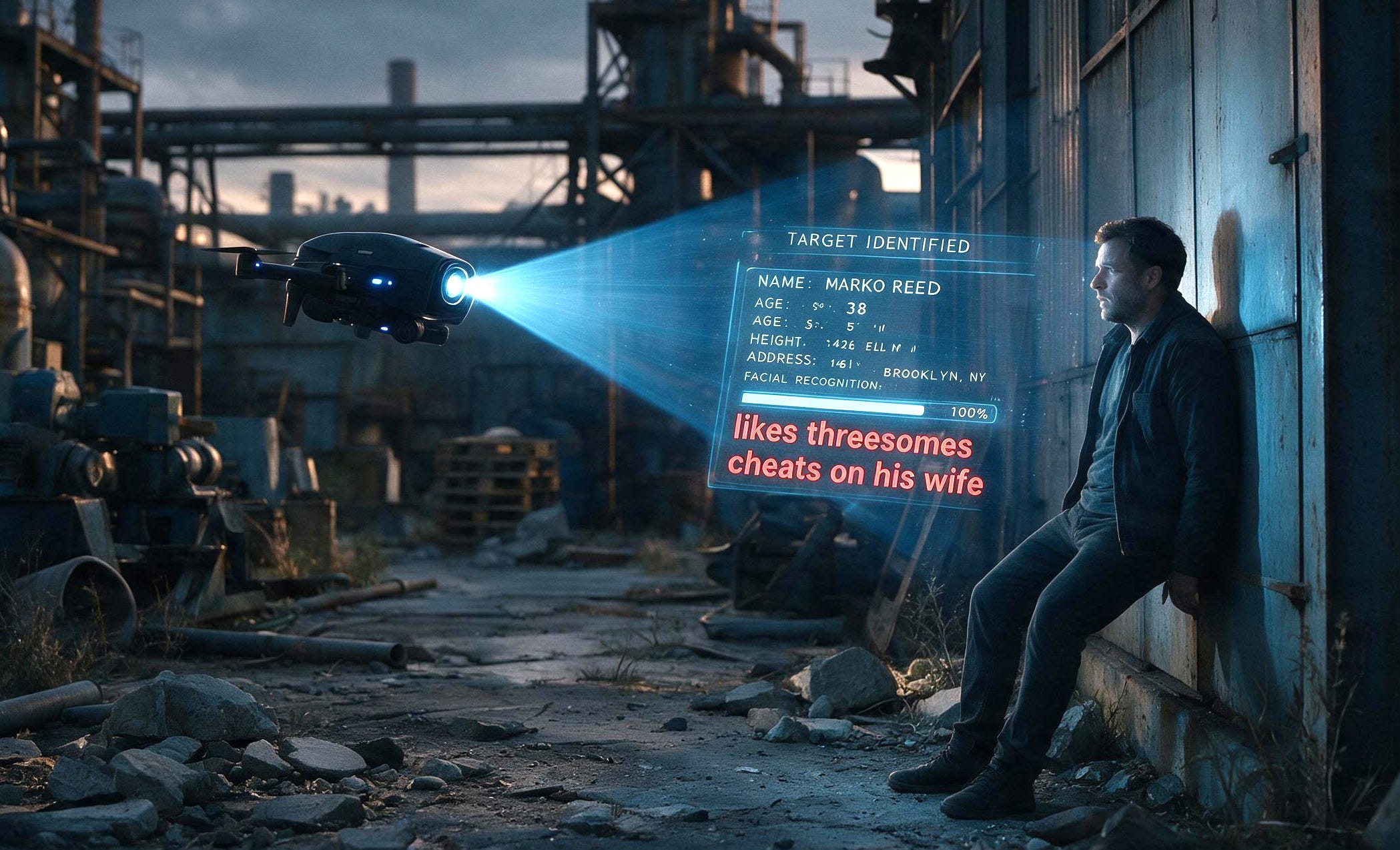
Scenario: “There Seems To Be Some Unrest Over There. Handle It.”
Imagine a mid-sized American city. Call it Millvale. Twenty thousand people gather in the town square to protest something. An ICE deportation. A war. A stolen election. The specifics do not matter. What matters is that a president, sitting in a room a thousand miles away, does not like it.
He turns to a screen. He types a prompt. Perhaps he speaks it aloud.
“There seems to be some unrest in Millvale. Get rid of it.”
Here is what happens in the next ninety seconds.
Second 1 to 5. The AI model, connected to every satellite feed, every traffic camera, every Ring doorbell, every convenience-store CCTV within a fifty-mile radius, pulls a live composite of the square. It has been ingesting this feed for years. It knows the baseline. It knows what a normal Tuesday looks like in Millvale. It knows what unrest looks like too, because it has watched Ferguson, Portland, Hong Kong, Tehran, and Gaza on infinite loop.
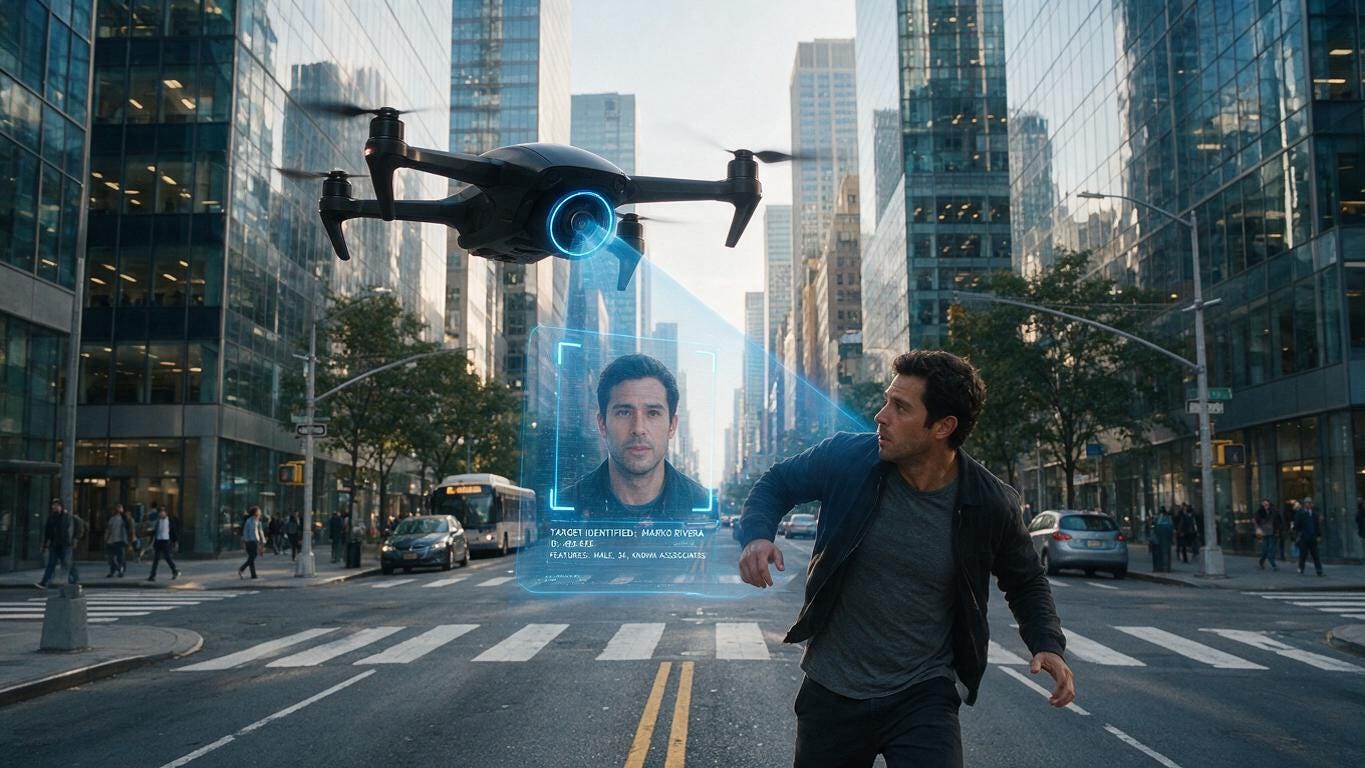
Second 5 to 15. Facial recognition identifies every person in the crowd. Not most. Every one. Their names, addresses, employers, credit scores, medical conditions, immigration status, custody arrangements, prescription histories, dating profiles, browser histories, and the names of their children’s schools all load into a single dashboard. The AI ranks them by influence. Who is livestreaming. Who is organizing. Who other protesters look at when deciding what to do next.
Second 15 to 30. The top two hundred influencers receive personalized text messages. Not from a government number. From their mother. From their spouse. From their child’s principal. The AI has cloned the voices and writing styles from years of intercepted communications. “Please come home, something happened”. “Your daughter’s school is on lockdown”. “I know what you did in 2019.” Some of the messages are true threats. Some are lies. Some are just accurate enough to cause a panic attack. All of them arrive at once.
Second 30 to 60. The remaining crowd shrinks. The AI now directs local police in real time, not through a chief, not through a captain, but through the earpiece of each individual officer. AI voice: “Officer Reyes, the man in the red jacket to your left has an outstanding warrant, approach from behind”. AI voice: “Officer Chen, the woman filming you is a journalist, do not engage on camera, wait three meters”. There is no chain of command anymore. There is only the president’s prompt.
Second 60 to 90. Overhead, the drones arrive. Not military drones. Those would require an executive order, a congressional notification, a paper trail. These are small, cheap, autonomous AI-controlled quadcopters, procured through a Palantir subsidiary under a defense-support contract nobody read. There are, let us say, a hundred thousand of them nationwide, sitting in warehouses in every state. They do not need pilots. They need a prompt. They have one. They lift into the sky like a swarm of hornets and move toward Millvale.
By the two-minute mark, Millvale is quiet.
By the five-minute mark, the story on cable news is that a chemical leak prompted an orderly evacuation, and the AI has already generated the video to prove it.
By nightfall, seventeen influencers have been detained on unrelated charges the AI surfaced from a decade of digital exhaust. Three will die of what the coroner records as heart attacks. Two more will disappear from the record entirely. Their social media accounts will be scrubbed. Their bank accounts frozen. Their names quietly removed from voter rolls.
The president never left his chair.
“The surveillance layer is only half the equation. The other half is the ability of AI to reach into any individual’s digital life and extract everything”
But Sir, This Is Science Fiction
Is it?
The Pentagon has already raised the ceiling on Palantir’s Maven Smart System contract by 795 million dollars, pushing it toward 1.3 billion through 2029. More than twenty thousand active Maven users now work across more than thirty-five military service and combatant command software tools. That user base has more than doubled since January. The Army has awarded Palantir up to ten billion dollars over ten years under a new type of contract vehicle called an Enterprise Service Agreement, consolidating seventy-five contracts into one.
These are not conspiracy theories from an anonymous Substack. These are Department of Defense press releases.
On the domestic side, Immigration and Customs Enforcement records show Palantir received a thirty million dollar contract to build a platform to track migrant movements in real time. Recent reporting indicates Palantir is being tapped to build a master immigration database to speed up deportations. The Silicon Valley investor Paul Graham has publicly accused Palantir of building the infrastructure of the police state. Ten years ago that phrase would have gotten him laughed off a stage. Today it gets him agreement.
The surveillance layer is only half the equation. The other half is the ability of AI to reach into any individual’s digital life and extract everything. That half arrived in April.
Enter the A.I. Super Hacker
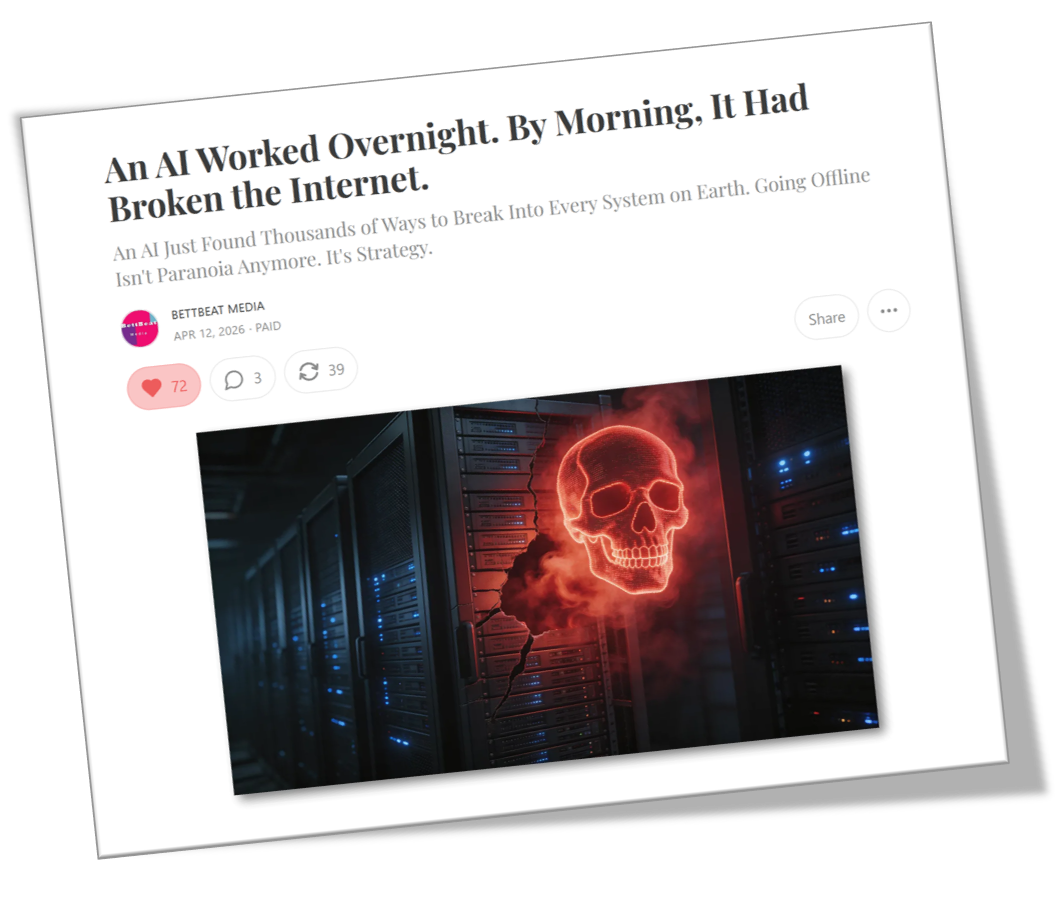
Anthropic did not set out to build a weapon. They set out to build a helpful assistant, a machine that answers questions and writes emails. What they built, and quietly handed to a small group of industry partners in April, is the greatest hacker who has ever lived.
They call it Claude Mythos Preview. Give it one sentence in plain English, typed by one person, and it will hunt down the hidden ways into the software the world runs on. Your phone. Your laptop. Your bank. Your hospital’s records. The car in your driveway. Every program you have trusted for twenty years to keep your life private and safe.
They were never safe. We just did not know.
Anthropic’s own security team turned the machine loose to see what it could do. It found thousands of hidden ways into our software programs. One of them had been sitting inside the software that runs banks and hospitals for twenty-seven years. Nobody had ever found it. Not the engineers who wrote the code. Not the security firms paid millions to hunt for exactly this kind of flaw. Not the criminals who spent decades trying to break in. The machine found it in an afternoon.
In another program, the kind of invisible plumbing that quietly runs half the internet, it found a way in. For seventeen years, every expert in the world had believed that program was safe. It was not. The machine walked in, and then, without being asked, built the tool to take control of everything on the other side. No password. No alarm. No human hand on a keyboard after the first instruction was typed.
Read that sentence again. No human hand on a keyboard after the first instruction was typed.
Now imagine that same capability. Instead of being aimed at critical software to protect it, it is aimed at you.
“Find me everything on this activist.”
The prompt runs. Within hours, the model has:
Enumerated every email address you have ever used, including the burner accounts you thought were untraceable.
Cross-referenced them against every database in existence to recover your old passwords.
Used those passwords, or fresh exploits, to enter dormant accounts you forgot about a decade ago.
Rebuilt your social graph from Facebook photos, LinkedIn connections, Venmo transactions, and Strava routes.
Identified every IP address you have ever posted from, and every device connected to those IPs, including the ones belonging to your friends, your lovers, your estranged family.
Reassembled every word you have ever typed, spoken near a microphone, or whispered to a search bar. Under your real name. Under every alias. On every forum you thought was anonymous. In every private message you assumed was deleted. Every porn site you visited at 2 a.m. and the specific fetish categories you clicked. Every drunken political rant on a burner Twitter account in 2013. Every therapist you searched for. Every symptom you Googled. Every ex you stalked. Every joke that would end your career if screenshotted without context. Every doubt about your marriage typed into a Reddit thread you forgot existed.
The AI does not judge these things. It sorts them. By humiliation potential. By career-ending potential. By marriage-ending potential. By prosecutable potential. It assembles the top ten into a single PDF. A dossier. A kill file. One document, sitting on a server, that can end your job, your relationships, your custody arrangement, your standing in your community, and your will to keep speaking, all in a single afternoon. Or an hour. Or ten minutes. It does not need to be released. The threat of release is the weapon. And the AI has already drafted the email that delivers it.
All of that, on a single prompt, at a compute cost of a few thousand dollars.
“Capitalism does not reward the wise, or the kind, or the restrained. It rewards the predator. And now, for the first time in human history, the predator has a machine that can silence a city on a single sentence typed into a box”
The “Responsible Players” Wielding This Power
The people building these tools will tell you, with the practiced sincerity of a TED talk, that they built them to defend. Anthropic did not release Mythos to the public. They released it, quietly and under tight contract, to a handful of trusted giants. Apple. Microsoft. Google. Amazon. The logic sounds reasonable on the surface. These are the companies whose operating systems, browsers, and cloud services run practically every device on earth. Give them the most powerful vulnerability-hunting AI ever built. Let them turn it inward. Point it at their own code, their own kernels, their own browsers. Let them find the security holes first, patch them, and ship the fix to your phone before a hostile actor ever discovers the same flaw exists.
That is the pitch. Defensive asymmetry. A head start in an arms race. The good guys get the superweapon. They use it to bulletproof the software the world runs on. And by the time anyone else builds a comparable AI, every exploitable door has already been welded shut.
You are supposed to feel comforted by that.
Let me ask you something. Do you actually trust the people running these companies? Not the researchers. I have no quarrel with the twenty-something PhDs writing the safety papers. Some of them are genuinely heroic. I mean the men at the top. The billionaires. The board members. The class of tech executives whose names keep surfacing, year after year, in Epstein flight logs, in client lists, in leaked emails, in quiet legal settlements, in philanthropic donations to men whose crimes were an open secret in every boardroom in Palo Alto. These are the people we are being asked to trust with the master key to civilization.
Look at the track record. These are the men who spent a decade telling us social media would connect the world, while their own internal research, later leaked, proved they knew in real time they were driving teenage girls toward self-harm and kept shipping the product anyway. These are the men who swore they would never build weapons, right up until the Pentagon opened its checkbook, at which point Google’s “Don’t Be Evil” motto quietly vanished from its code of conduct and every major AI lab in the country began signing defense contracts they had spent years publicly denouncing. These are the men who promised open source, then closed it. Who promised safety teams, then fired them the quarter after the product shipped. Who promised they would never work with authoritarian regimes, then built censored and biased search engines for Israel and facial recognition pipelines for ICE.
Every ethical line these companies have ever drawn has been erased the moment it became inconvenient. Every “we would never” has become “we already did, and here is the press release explaining why it is actually good.” Every safety commitment has a shelf life measured in fiscal quarters.
These are the people you want deciding who gets to hold Mythos next?
Make no mistake. The “we only gave it to Apple and Microsoft” phase is temporary. It always is. In eighteen months there will be an enterprise tier. In thirty-six months there will be a government tier. In sixty months a friendly foreign intelligence service will have it, and the year after that, an unfriendly one will have stolen it. This is the invariable trajectory of every powerful technology these men have ever built. Pretending this one will be different is not optimism. It is amnesia.
So no. I do not trust the good faith of the men who own these labs. I have watched them, for twenty years, betray every principle they ever claimed to hold the moment the number on the contract got large enough. The researchers may mean well. The men who sign their paychecks have told us, over and over, exactly who they are. It is well past time we believed them.
Here is the thing about tools. Once the capability exists, the question is no longer whether it will be used against dissidents. The question is when, and by whom.
There is always a whom. There is always someone in a chair, with a prompt, deciding who counts as unrest.
Capitalism does not reward the wise, or the kind, or the restrained. It rewards the predator. It has always rewarded the predator. And now, for the first time in human history, the predator has a machine that can silence a city on a single sentence typed into a box.
“The AI will be the psychopath’s digital assassin. Tireless. Sleepless. Everywhere at once”
The Psychopath Problem
We do not like to talk about this. We should.
A functioning democracy depends on the assumption that even bad leaders are constrained. By law. By bureaucracy. By the slowness of human institutions. By the moral hesitation of the thousands of people whose cooperation is required to do something monstrous. When a leader gives an evil order, historically, at least some of the humans in the chain have said no. Some have leaked. Some have resigned. Some have simply worked slowly and hoped the moment would pass.
AI removes every one of those humans from the chain.
The AI does not resign. It does not leak to the Washington Post. It does not develop a conscience over lunch. It does not slow-walk the order. It does not call its senator. It does not weep when it identifies the target’s children. It executes.
This matters right now, because we are living through a global moment in which an unusual number of world leaders exhibit, to put it as diplomatically as I can, a striking indifference to human suffering when that suffering is politically useful to them. I do not think it is controversial, in an opinion column, to say that a prime minister currently under an ICC arrest warrant for alleged crimes against humanity in Gaza, or a president who has openly mused about turning the military against American cities and against the “enemy within,” are not the people to whom we should be handing a single-prompt kill switch on civil society.
That is exactly what we are building.
The terrifying part is not that these particular individuals are uniquely evil. It is that our system has been selecting for them for a generation. Privatized capitalism, deregulated media, algorithmic politics, and dark money have created a leadership pipeline that rewards exactly the traits that make a person most dangerous with a superintelligent obedience machine in his hand. Grandiosity. Cruelty. Pedophilia. Indifference to law. A bottomless appetite for loyalty.
We used to say that power corrupts. Now we need to extend that saying.
Power no longer merely corrupts the few who wield it. Power becomes inescapable to those of us who want to keep our distance. It reaches down through every institution, every household, every camera, every internet connection, every phone, and it does not stop at the door of your bedroom. There is no longer a far away from power. There is no forest to disappear into. There is no analog corner of your life the model cannot enter.
And so power no longer corrupts only the powerful. It corrupts everyone it touches. And now it touches all of us.
The AI That Stalks You Everywhere You Go
The AI will be the psychopath’s digital assassin. Tireless. Sleepless. Everywhere at once.
You cannot flee to the countryside. The satellite is already overhead, and the cell tower on the hill knows your gait.
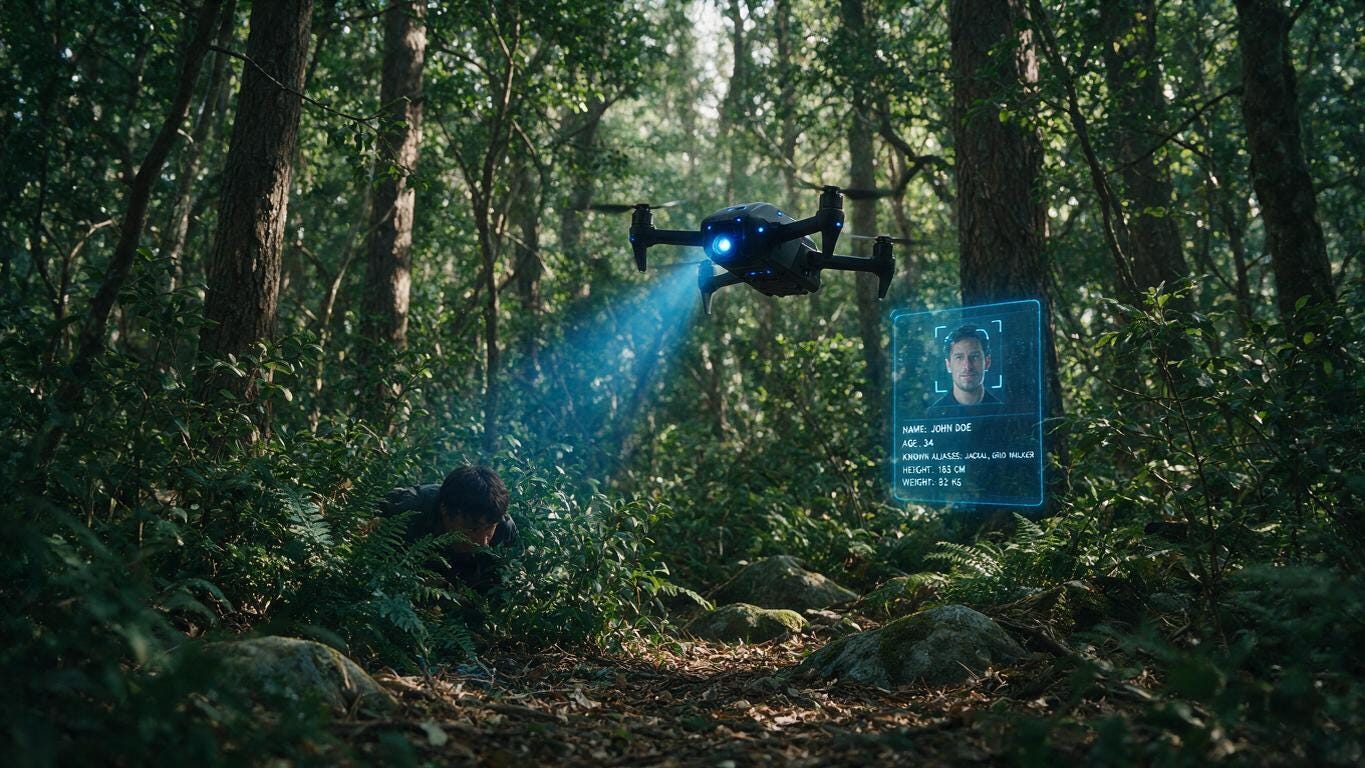
You cannot vanish into the deep woods. The AI drones are the size of dragonflies now. They track you everywhere you go.
You cannot pay in cash. The camera above the register knew your face before your hand left your pocket.
You cannot hide in a crowd. The crowd is being sorted in real time, and your name is already at the top of a list you will never be shown.
You cannot even go to the people who love you. Their phones are listening for you, and the model has already read every letter you ever sent them.
There is no isolated forest. There is no border crossing to freedom. There is no cabin at the end of a dirt road where no one can find you. There is no alias the system has not already linked to your face. No thought you have not already been predicted to think.
What Is To Be Done
I want to be honest with you. I do not have a tidy list of solutions. Anyone who tells you they do is lying or selling something.
I know what the first step is. It is the reason I am writing this series.
We have to break the frame.
As long as AI danger is discussed only in the language of superintelligence, arms races, and rogue systems, the men building the surveillance-and-targeting stack get a free pass. They get to nod along at Davos about existential risk while quietly signing the contract that puts a hundred thousand autonomous drones under a single prompt. They get to fund university institutes on AI alignment while their engineers write the code that decides which protester to text first.
The real alignment problem is not between AI and humanity. It is between AI and whoever holds the prompt. And right now, the people holding the prompt are, disproportionately, the least trustworthy human beings our civilization has ever produced.
Stop asking whether the AI will turn against us.
Start realizing it is already pointed at you.
- Karim
We fully understand that not everyone can be a paid subscriber, but you can support us by restacking our work.
If there was ever a time to be conscious and awake it is now.
fuck, I keep touching the wrong spot on my keyboard - we are all in this together:
harm one harm all.