
Why Does China Keep Rescuing the Empire That Wants It Dead?
China now faces an encirclement crisis of the kind that took down the Soviets.

We fully understand that not everyone can be a paid subscriber, but you can support us by restacking our work.
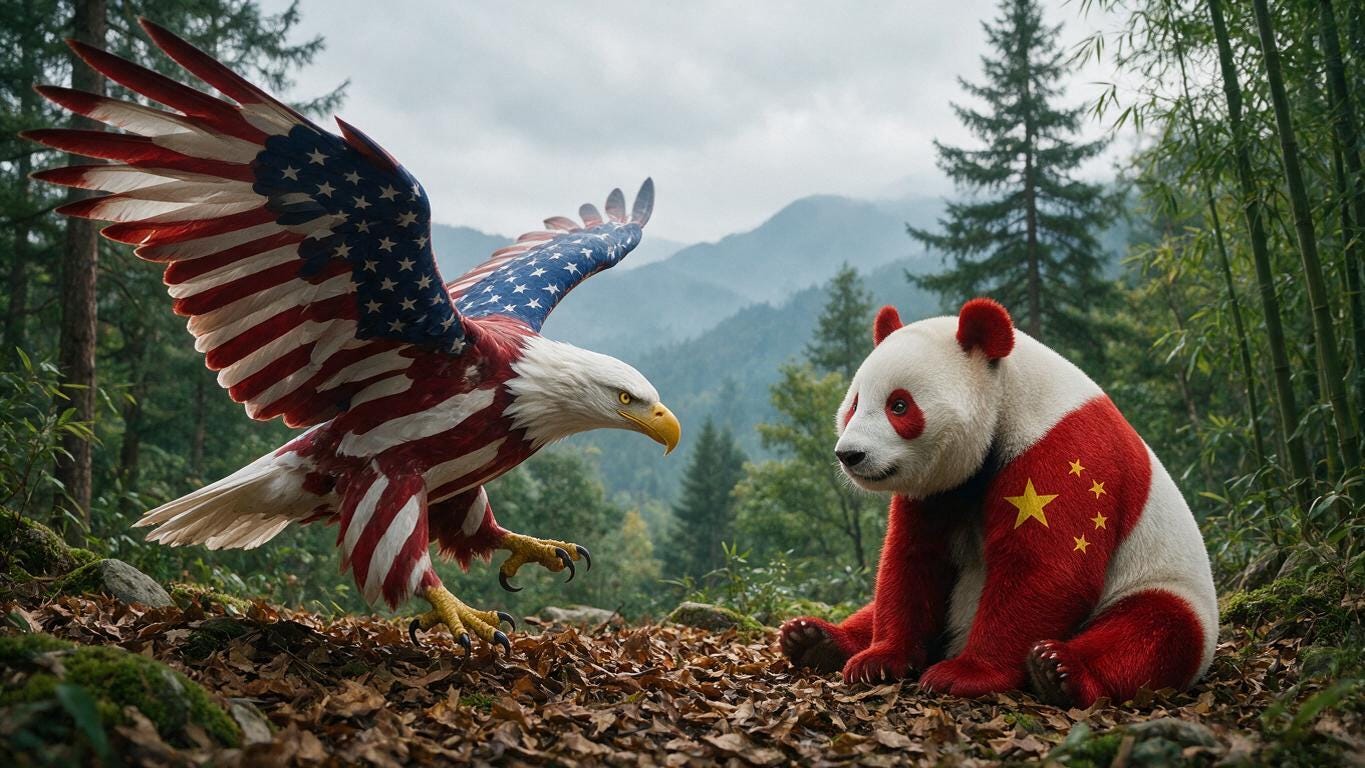
Most outlets critical of imperialism will serve you a feel-good story. Critical engagement with China’s foreign policy is heresy in these circles, verboten. Not at BettBeat Media. We genuinely try to find answers to the questions that concern Empire. And while we hold great love and respect for China, we are one of the few outlets that dare to question its puzzling posture toward an empire that no longer hides its intention to destroy it.
We want China to thrive. We want it to win, even, against an empire hellbent on burning this world. But for China to win, its actions that court defeat must be questioned. You are no friend of China if you applaud everything it does, including the suicidal.
If it is triumphalism you want, stop reading now. Ninety-nine percent of anti-imperialist commentary will give you exactly that. You have an abundance of choice.
China has built the world’s most formidable engineering culture but neglected to teach its people what imperialism is. The children of its elite are shipped to Harvard and Yale like tribute.
China’s Silence
The president of the United States left a NATO summit in Turkey the way a fugitive leaves a hotel, hustled across the tarmac, by some accounts in a catering vehicle, and placed aboard a decoy plane while his cabinet officers and the traveling press were left behind as bait.
Empires end this way. Not in a single thunderclap but in small indignities, in farce, in the spectacle of a ruler who bets the lives of his underlings against his own and calls it statecraft. Bigly.
The war against Iran, sold as a swift act of chastisement, has become a slow public bleeding. The missiles keep coming, from factories buried too deep for the bombers to reach. The Gulf monarchies, who can read a wind shift faster than any intelligence agency, have begun writing their own insurance policies, signing defense pacts with Ankara and Islamabad that pointedly do not include Washington. Some suspect Washington’s hand behind these pacts, a buffer against Iran assembled at arm’s length, but even if true, it is the maneuver of a power that must now work through intermediaries because its own word carries no weight. Gasoline prices function as a pay cut imposed on every American worker. The Treasury, gorged on Pentagon debt and a speculative artificial intelligence binge, is reduced to propping up the Japanese yen the way a drunk props up the man he is drinking with.
Gerald Horne, the historian and longtime friend of BettBeat Media, is right. The old formula of violence and subterfuge that built the settler republic, that cleared the continent and filled the slave ships, no longer produces obedience. It produces humiliation and, more corrosive still, disgust. Disgust from a world that sees the emperor without his clothes, that watches the self-anointed beacon of human rights, the shining city on a hill, feed its addiction to mass murder in the open, without shame and without pretense.
And yet the strangest silence in this moment does not come from Washington. It comes from Beijing.
How socialist can one be, I wonder, when one can imagine a win-win arrangement with the global hegemon of imperialist capitalism?
The one power on earth with the industrial depth, the financial reserves and the human talent to hasten the end of the American imperium behaves instead like a creditor terrified of offending a bankrupt debtor. It watches the wounded beast stagger and rushes forward, again and again, not with a spear but with a cushion.
Encircling China
Consider what is being prepared. Washington is stitching a cordon around China from Japan to India to Australia to South Korea, and courting Vietnam to close the circle. Gerald Horne reminds us that encirclement is not a metaphor. It is the strategy that broke the Soviet Union, which by its final decade faced hostile powers on every frontier and spent itself into the grave trying to answer them all. The darkest irony is that Beijing helped tie that noose. It aligned with Washington against Moscow in the 1970s and 1980s and told itself this was shrewdness. Now the same rope is being measured for its own neck, and its answer is a white paper on mutual benefit and ‘win win’.
How socialist can one be, I wonder, when one can imagine a win-win arrangement with the global hegemon of imperialist capitalism?
Richard Nixon, near the end of his life, worried aloud that his opening to China had created a monster he could not control. He need not have worried. The monster turned out to want nothing so much as the master’s approval. Here, perhaps, is the great unspoken wound in Chinese strategic culture: the belief, held with the fervor of a convert, that enough production, enough patents, enough patience will finally purchase admission to the club.
The journalist John Helmer said of Russia’s leader that “Putin doesn’t understand imperialism.” Putin believed for two decades that the West would eventually accept Russia as a partner, and not even sanctions, coups and war seem to have educated him out of that belief. There is every reason to fear the same naivety in Beijing. The Western imperial order does not take partners. It takes servants, and it takes targets. There is no third category, and wealth does not create one.
China’s Puzzling Passivity
China’s record of the last fifteen years reads like a ledger of abstentions. Libya was disemboweled in 2011 while China stood aside in the Security Council, evacuated its workers and issued its regrets. Syria endured a decade of proxy war, its cities ground to powder, and China contributed statements. Venezuela was strangled slowly, publicly, by sanctions designed to make its people scream, then its leader was kidnapped and its government handed to Washington’s caretakers, and Beijing responded with the usual passivity.
Each time the Empire devoured a state, the Chinese foreign ministry expressed concern, called for dialogue and went back to work. Each meal made the predator stronger and the next target lonelier. Passivity did not buy safety. It bought time, and the time fattened the monster.
The pattern extends to oil. A serious rival would understand that the American war machine floats on cheap energy and calm markets, that every panic at the pump is a tax on the Empire’s legitimacy. Iran and the Arab resistance now fight the monster alone, and I watch with wonder as Beijing taps its own reserves to soothe the very markets whose convulsions would do more damage to Washington than a fleet of frigates. Iranian resistance does the bleeding. Chinese refiners do the saving. The Empire does the breathing.
So appreciated was China’s abstention that Trump took the trouble to say thank you in public. “I want to thank China because I asked China not to get involved with Iran,” he announced. When the emperor is grateful, the vassal should worry.
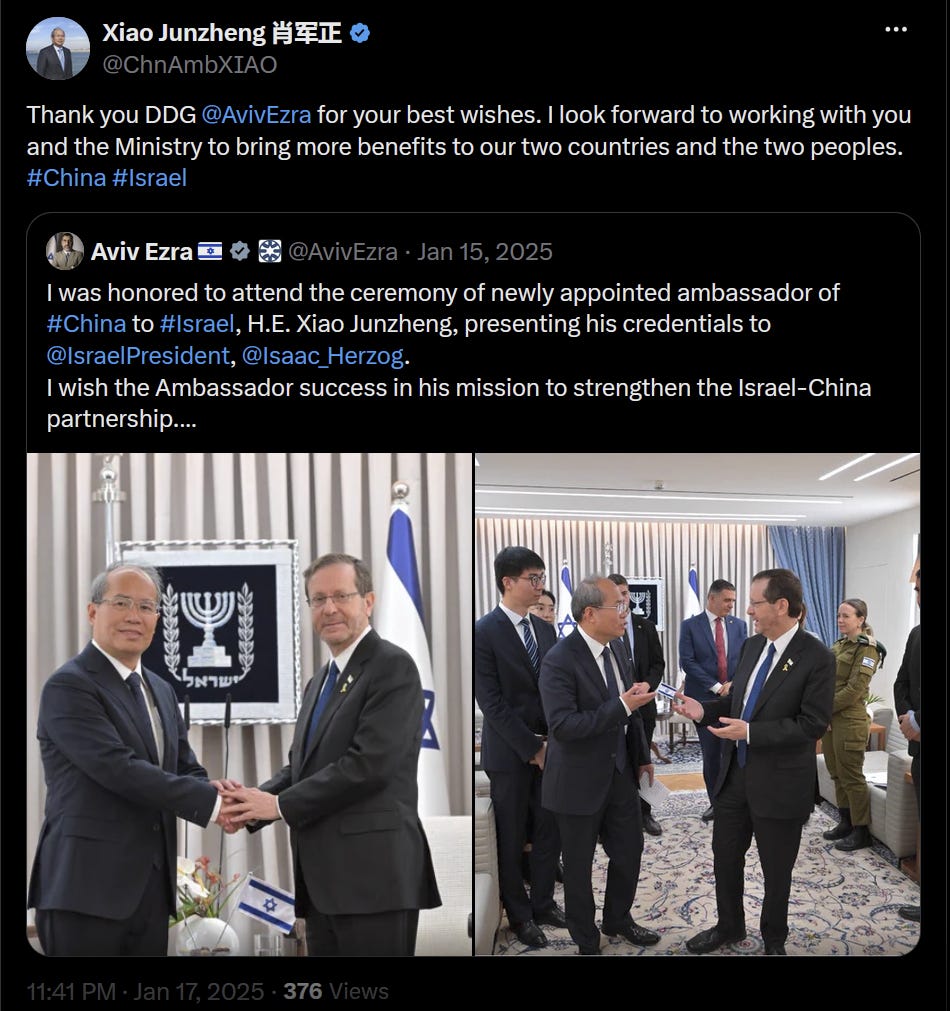
My bewilderment extends to China’s relationship with Israel. Here is a state that functions as the attack dog of American empire in West Asia, the instrument of a genocidal war conducted before the cameras of the world, and China’s answer has been commerce: port terminals, technology deals, trade volumes that climbed while Gaza burned.
A country that calls itself socialist might be expected to remember what internationalism once meant, when volunteers crossed oceans for Spain and Cuban soldiers helped break the back of apartheid on the battlefields of Angola. Where is that spirit in Beijing’s Palestine policy? Where is it in Caracas? Solidarity has been replaced by commerce capitalism.
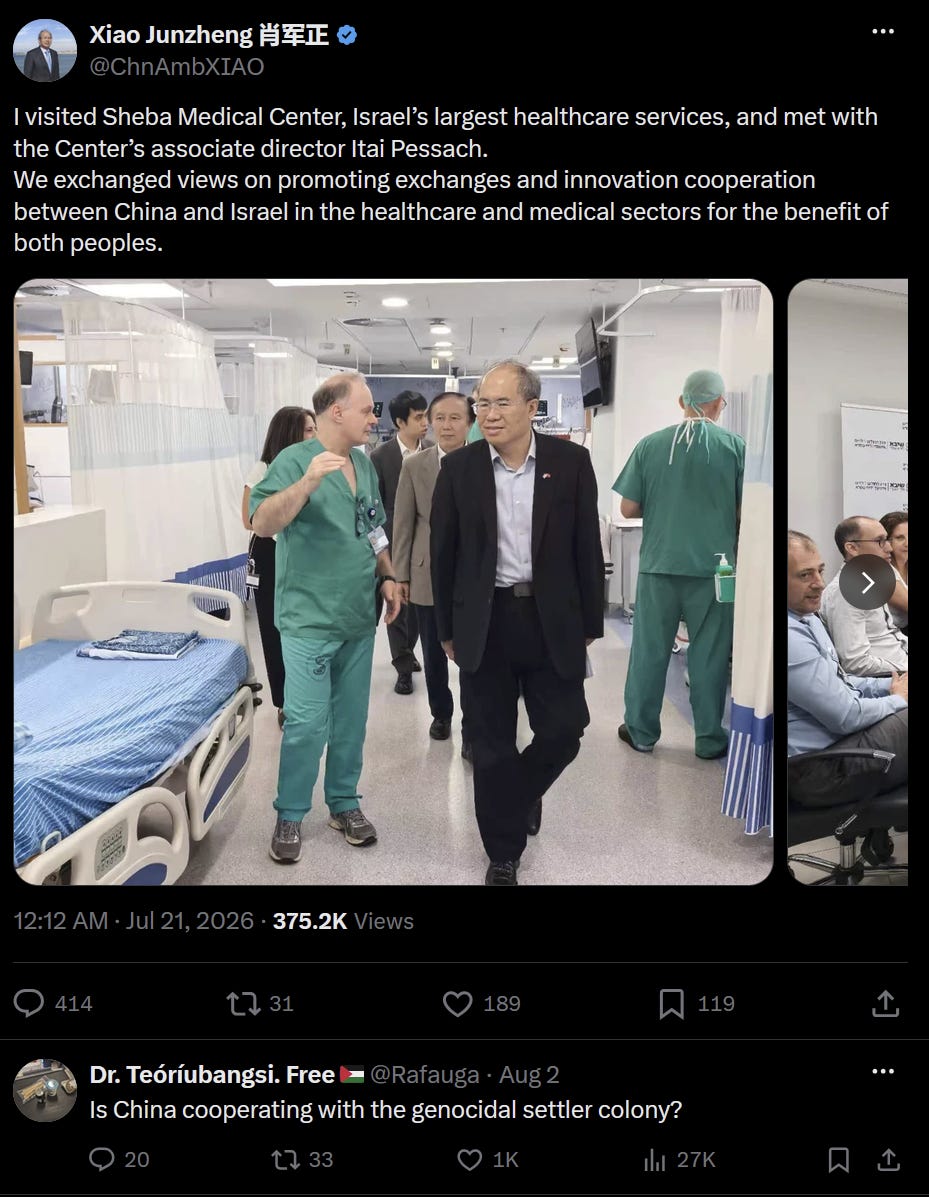
And the empire has noticed the vacancy. Its answer to Chinese restraint abroad is subversion at home. While Beijing celebrates its cooperation with Israel, that same Israel and its imperial patron spent years training Uyghur fighters in the Syrian war, organized, armed and kept in reserve like a knife laid quietly on the table during a negotiation. This is the oldest imperial trick in the book, the cultivation of a wound inside the rival's own body. A power that refuses to contest the Empire in Damascus will eventually meet it in Kashgar, on terms the Empire has chosen.
The door out of the American century stands open. And China, brilliant, industrious, sleepless China, stands before that open door rehearsing courtesies, checking its trade balances, waiting for an invitation that will never come.
Imperial Illiteracy
The deeper failure is internal, and it is a failure of the mind. China has built the world’s most formidable engineering culture but neglected to teach its people what imperialism is. The children of its elite are shipped to Harvard and Yale like tribute. Hollywood is adored. The economics departments of great Chinese universities teach the neoliberal doctrine.
A population that has never been given the intellectual tools to see imperialism will not recognize it when it arrives, and will mistake its flattery for friendship and its universities for neutral ground.
Nowhere is this blindness more painful than on the question of race. Schools across China advertise for “Caucasian” English teachers, as if whiteness itself were a credential. Whiteness is flattered. Chinese netizens recite anti-woke catechisms minted in the Empire’s culture war furnaces, apparently unaware that the racial hierarchy they are applauding files them beneath the same boot, that the yellow peril posters of the last century are being reprinted with better graphics.
W.E.B. Du Bois, who spent his ninety-first birthday honored in Beijing, understood that the color line and Empire were a single system, two names for one machinery of domination. The country that once feted him seems to have forgotten what he taught.
This is what comes of believing that STEM and GDP constitute a civilization’s defense. Engineers cannot decode hegemony. Quants cannot read a proxy war. A nation that builds fusion reactors but starves its critical social sciences, that treats sociology and history as decoration rather than armament, will be outmaneuvered by a rival that mints storytellers, image makers and foreign intelligence officers by the tens of thousands.
Gramsci understood that power rules first through the stories people accept as common sense. The Empire’s most successful export to China was never soybeans or semiconductors. It was common sense.
The Predator’s Prey
So we arrive at the euphemisms. Read any Chinese statement on the wars, the sanctions, the carrier groups off its coast, and you will find the same ghostly locutions: certain countries, some forces, relevant parties. The United States is the unnamed weather in every forecast. But naming is the first act of resistance. Every colonized people has known this. A state that cannot bring itself to say the word adversary has surrendered the power to define its own situation, and a diplomacy this patient begins to shade into something suicidal.
There is a saying, coined of all people by an American white supremacist, that to learn who rules over you, you need only find out who you are not allowed to criticize. He understood domination from the inside, the way a jailer understands locks. Apply his test to Beijing's communiqués and the verdict is immediate. The one power never named, never criticized, never confronted in plain language is the one power working openly toward China's destruction. The silence is deafening.
The bitter joke of this moment is that the Empire has rarely been weaker. Iran exposed its military limits. Its treasury is a bonfire. Its client regimes in Latin America are a retreat dressed up as an advance, the reflex of a power falling back to its own hemisphere. The door out of the American century stands open. And China, brilliant, industrious, sleepless China, stands before that open door rehearsing courtesies, checking its trade balances, waiting for an invitation that will never come.
The Soviets also believed time was on their side. They believed the correlation of forces was shifting, that patience was strategy, that the encirclement was manageable. Their flag came down anyway. Empires are not appeased into decency, and they are not outlasted by those who refuse to see them. They are named, confronted and stopped. The men in Beijing still believe they can be the exception, the rival that is finally forgiven for rising. History has a word for powers that hold this belief, and the word is prey.
- Karim
We fully understand that not everyone can be a paid subscriber, but you can support us by restacking our work.
I just restarted my subscription. This is an important subject and I appreciate this work.
Jeffrey Sachs has reported that the COVID project was, from the beginning, a joint China/USA project.
Bill Gates and the CPC are the two heaviest funders of the WHO.
The Adelson family which owns the money laundering casinos in Vegas also control 50% of the gambling trade in Macau a Chinese SAR.
With Hong Kong and Macau powerful Chinese have full access to the “offshore” dark money system.
I don't know if I agree or disagree, because I didn't see a part in the essay where you laid out your proposed alternative strategy for China. It is certainly implied, but laying it out would be helpful to begin seeing how to navigate the various reactions within the complex system of international politics (e.g., you imply ending the Five Principles of Peaceful Co-Existence, but to replace it with what? And with Pandora's box opened to diplomatic pressure from all over the world to use trade as a weapon like the US, how to manage the maelstrom?). Keeping it only implied does an end run around all of this, but it is well worth addressing directly - if only because without doing so, people familiar with it will dismiss the argument entirely as unserious. You paint with an overbroad brush in parts, e.g., Chinese econ departments are not uniformly neoliberal or neoclassical (https://www.routledge.com/Competing-Economic-Paradigms-in-China-The-Co-Evolution-of-Economic-Events-Economic-Theory-and-Economics-Education-19762016/Cohn/p/book/9780367878023), but absolutely, the fact that any pseudoscientific apologetics for US-variety capitalism has even one proponent in China is an intellectual atrocity, I agree; and yes indeed there is a Right in China and if anything they are even worse than what you allude to here (e.g., https://www.tandfonline.com/doi/full/10.1080/10670564.2020.1766911 - though one would hope that a decade of reality smacking them up the side of the head would suffice to change many minds on these points, but then again we are talking about rightists so...), but thankfully they are not in control of the country or else the tenor of Western media coverage would be substantially more positive. If Westerners can be of any help in internal political debates, I am more than happy to join in, but for that I would need someone fluent in those debates, and of course in Chinese, to enlighten me as to how. Otherwise what is most important is:
'If you are a Western leftist, feel free to judge the Chinese government as bad or good or anywhere in between - for not taking the action you think appropriate, or for doing exactly what you think is appropriate. Such judgments matter little, for the same reason that rightists’ arguments against protesting our own government and its dependencies are invalid (for instance, “why are you protesting for women’s rights in the U.S.!? Don’t you know that in EYE-RAN, women have no rights, why don’t you protest against them?” or “why are you protesting against the Israeli government!? Don’t you know that there is mass murder in Ethiopia or Sudan or Myanmar, why don’t you protest against them?”). Because citizens of the U.S. have some, if minor, influence over their own government’s policies, whereas we have zero influence over other governments. Your moral condemnation or approval of foreign governments (that aren’t dependencies of the U.S.) are as consequential as your judgment on whether or not Blackpink and Taylor Swift are laudable musicians.
Except in one respect.
This requires a bit of history to explain. During the Cold War, the CIA provided funding for a “compatible Left” – that is, a “Left” compatible with the US empire, and suitably anti-Soviet – from labor unions to leftwing political parties and intellectuals. To the U.S. Right, this was terribly immoral. Giving money to godless socialists, degenerate artists, and labor unions (the thugs who extort upright employers, denying them their god-given authority over the lower orders)? This was a moral stain on the CIA, defensible only insofar as this unquestionable immorality served a greater good. And that greater good was supporting the U.S. empire, by convincing as many leftists as possible that actually existing socialist governments were in fact bad, for whatever reason stuck. The reasoning didn’t matter – what did matter was getting leftists to judge the USSR as “bad”, to feel antipathy toward it, so they would be less likely to lend their support to any movement or organization associated with the USSR, and less likely to (or more tepidly) oppose U.S. anti-communist foreign policy. Which of course needed as much opposition as possible, considering that U.S. anti-communist foreign policy included so much torture, murder, and other barbarities around the world as to make the IDF in Gaza look like the Girl Scouts on a charity drive.
But if enough erstwhile or would-be leftists could be convinced that the USSR was bad – even if also bad, along with the U.S. – and kept away by the perceived stench of Soviet immorality from taking political actions in line with Soviet foreign policy aims or against U.S. aims, then that was a win for the CIA and the empire it serves. For instance, the last time the U.S. government perpetrated genocide: in Guatemala, the more would-be/erstwhile leftists who could be made to believe that the also-evil Soviets were behind the insurgency, the better. They’d reason: why make a big deal about the U.S. efforts to defend the Guatemalan or Salvadoran governments against the immoral Soviets? (This was made a lot easier by the lack of smartphones broadcasting U.S.-trained Guatemalan soldiers torturing and massacring entire villages, or U.S.-trained Salvadoran soldiers flaying babies to death with barbed wire in front of their mothers.) A pox on both their houses, I say, for a morally pure leftist individual like myself!
To create a “Left” compatible with the U.S. empire required only a negative moral judgement of actually existing socialist governments. A positive view of the U.S. empire would be the cherry on top, but entirely unnecessary. (And too hard to instill.) Instead, it sufficed to promote a universalist humanism which condemned the U.S. empire and the USSR alike; “neither Washington nor Moscow”, nor Beijing. Champagne bottles could pop in Langley so long as leftists could be made compatible with the U.S. empire in this limited way. As the Captain is told by his CIA handler in The Sympathizer: “as long as we can keep them within the nebulous bounds of humanism, but with no actionable political ideology, they’re completely harmless.”
Don’t be harmless. Judge the Chinese government however you like, but focus your political actions on civilizing your own government, ending the Dumb Cold War, and pushing for the existential necessity of an unprecedented degree of international cooperation to avert ecological catastrophe and nuclear holocaust. Be incompatible with empire. And if you have friends in China, talk to them about the ripe durians ready for picking, the soft power bonanza China could enjoy if it takes the lead against the genocide. Just avoid any laughable pretense of moral superiority: it is our governments actively perpetrating the genocide, and the onus is on us, primarily and overwhelmingly, to stop it. And, don’t act like your supposition about the eventual results of such a strategy is superior to any other supposition, particularly when you are not one of the 1.4 billion people with skin in the game, whose lives would be in jeopardy if your supposition turns out to be wrong.
Join a party or organization – for instance, in the U.S., DSA, in Europe, DiEM25 – and focus on improving it while you carry out collective tasks and attempt to educate normies into joining. It may be too late to stop the U.S./Israeli/European genocide in Gaza immediately, but there will be many more atrocities coming from the fanatics and crackpots comprising the U.S. foreign policy establishment – unless we are organized and numerous enough to stop them. Gramsci’s “pessimism of the intellect, optimism of the will” (be as pessimistic as you like in your analysis, but act as if you were full of optimism) is good advice. A politically pessimistic intellect is operating on plenty of suppositions about future states of a complex system; you very well may be wrong about them. So act as if you had a world to save, and a good chance of doing so. Because the former is true with absolute certainty, and the latter will be true if we act like it is.'
https://bettbeat.substack.com/p/magical-negros-mandarins-and-how